1-ISLAMIC STUDIES
Course Objectives: This course is aimed at;
1. To provide Basic information about Islamic Studies
2. To enhance understanding of the students regarding Islamic Civilization
3. To improve Students skill to perform prayers and other worships
4. To enhance the skill of the students for understanding of issues Related to faith
and religious life.
1. INTRODUCTION TO QURANIC STUDIES:
1. Basic Concepts of Quran
2. History of Quran
3. Uloom-ul -Quran
2. STUDY OF SELECTED TEXT OF HOLLY QURAN:
1. Verses of Surah Al-Baqra Related to Faith (Verse No. 284-286).
2. Verses of Surah Al-Hujrat Related to Adab Al-Nabi (Verse No. 1-18).
3. Verses of Surah Al-Mumanoon Related to Characteristics of faithful (Verse No.
1-11).
4. Verses of Surah al-Furqan Related to Social Ethics (Verse No. 63-77).
5. Verses of Surah Al-Inam Related to Ihkam (Verse No. 152-154).
3. STUDY OF SELECTED TEXT OF HOLLY QURAN:
1. Verses of Surah Al-Ihzab Related to Adab-al-Nabi (Verse No. 6, 21, 40, 56,
57, 58).
2. Verses of Surah Al-Hashar (18, 19, 20) Related to thinking, Day of Judgment.
3. Verses of Surah Al-Saf Related to Tafakar, Tadabar (Verse No. 1, 14).
4. SEERAT OF HOLY PROPHET (S.A.W) I:
1. Life of Muhammad Bin Abdullah ( Before Prophet Hood)
2. Life of Holy Prophet (S.A.W.) in Makkah
3. Important Lessons Derived from the life of Holy Prophet (S.A.W.) in Makkah
5. SEERAT OF HOLY PROPHET (S.A.W) II:
1. Life of Holy Prophet (S.A.W.) in Madina
2. Important Events of Life Holy Prophet (S.A.W.) in Madina
3. Important Lessons Derived from the life of Holy Prophet (S.A.W.) in Madina
6. INTRODUCTION TO SUNNAH:
1. Basic Concepts of Hadith
2. History of Hadith
3. Kinds of Hadith
4. Uloom –ul-Hadith
5. Sunnah & Hadith
6. Legal Position of Sunnah
7. SELECTED STUDY FROM TEXT OF HADITH:28
8. INTRODUCTION TO ISLAMIC LAW & JURISPRUDENCE:
1. Basic Concepts of Islamic Law & Jurisprudence
2. History & Importance of Islamic Law & Jurisprudence
3. Sources of Islamic Law & Jurisprudence
4. Nature of Differences in Islamic Law
5. Islam and Sectarianism
9. ISLAMIC CULTURE & CIVILIZATION:
1. Basic Concepts of Islamic Culture & Civilization
2. Historical Development of Islamic Culture & Civilization
3. Characteristics of Islamic Culture & Civilization
4. Islamic Culture & Civilization and Contemporary Issues
10. ISLAM & SCIENCE:
1. Basic Concepts of Islam & Science
2. Contributions of Muslims in the Development of Science
3. Quranic & Science
11. ISLAMIC ECONOMIC SYSTEM:
1. Basic Concepts of Islamic Economic System
2. Means of Distribution of wealth in Islamic Economics
3. Islamic Concept of Riba
4. Islamic Ways of Trade & Commerce
12. POLITICAL SYSTEM OF ISLAM:
1. Basic Concepts of Islamic Political System
2. Islamic Concept of Sovereignty
3. Basic Institutions of Govt. in Islam
13. ISLAMIC HISTORY:
1. Period of Khlaft-E-Rashida
2. Period of Ummayyads
3. Period of Abbasids
14. SOCIAL SYSTEM OF ISLAM:
1. Basic Concepts of Social System of Islam
2. Elements of Family
3. Ethical Values of Islam
![2-PHARMACEUTICS-IIA (Dosage Form Science) [THEORY]](https://lms.uhs.edu.pk/pluginfile.php/11106/course/overviewfiles/2-PHARM%20410.jpg)
2-PHARMACEUTICS-IIA (Dosage Form Science) [THEORY]
1. PHARMACEUTICAL CALCULATIONS: Some Fundamentals of Measurements
and Calculations. The Metric System. The Common Systems. Conversions.
Calculation of Doses. Percentage calculations, Reducing and Enlarging
Formulas. Weights and Volumes of Liquids. HLB Values. Industrial Calculations.
Calculations involving parenteral admixtures. Some calculations involving
Hydrogen-ion concentration. Calculations involving isotonic, electrolyte and
buffer solutions.
2. INTRODUCTION: Dosage form, Ingredient, Product formulation.
3. GALENICAL PREPARATIONS: Infusions, Decoctions, Extracts, Fluid extracts,
Tinctures, Aromatic waters.
4. SOLVENTS USED IN PHARMACEUTICAL PREPARATIONS:
5. ORAL SOLUTIONS, SYRUPS, ELIXIRS AND SPIRITS: Solutions: their
preparation, dry mixtures for solution, oral rehydrate solutions, oral colonic
lavage solution. Syrup: components and preparation of syrups. Elixirs:
Preparation of elixirs, Medicated and non-Medicated elixirs. Spirits: Preparation
of Spirits.
6. ORAL SUSPENSIONS, EMULSIONS, MAGMA AND GELS: Preparations,
examples and importance.
7. TOPICAL AND TRANSDERMAL DRUG DELIVERY SYSTEMS: Introduction of
Ointments, Creams, Pastes, Poultice, Plasters, Lotions, Liniments, Topical gels,
Topical Tinctures, Collodions, Topical solutions, Topical powders, Percutaneous
absorption, Transdermal systems in use.
8. OPHTHALMIC, NASAL AND OTIC PREPARATIONS: Ophthalmic solutions,
suspensions, ointment, inserts, contact lens solutions. Nasal decongestant
solutions, Decongestant inhalers. Ear preparations: Anti-infective, anti-
inflammatory and analgesic.
![3-PHARMACEUTICS-IIA (Dosage Form Science) [PRACTICAL]](https://lms.uhs.edu.pk/pluginfile.php/11108/course/overviewfiles/3-PHARM%20410.jpg)
3-PHARMACEUTICS-IIA (Dosage Form Science) [PRACTICAL]
NOTE: Practicals of the subject shall be designed from time to time on the basis
of the above mentioned theoretical topics and availability of the facilities e.g.
Prepartion of simple syrup, Orange syrup, Ferrous sulphate syrup, Cod Liver oil
Emulsion, Liquid paraffin Emulsion, Throat paint (Mandle’s paint), Boroglycerine
glycerite, Tannic acid glycerin, Spirit ammonia aromatic, Spirit of Ethyl Nitrite.
Preparation of Methyl salicylate ointment, Sulphur ointment, Calamine lotion,
Iodine tincture, Preparations of oral hygiene products, Poultice of Kaolin,
Effervescent granules, Distilled Water for Injections (A minimum of 10 practicals
will be conducted).
![4-PHARMACEUTICS-IIIA (Pharm. Microbiology & Immunology) [THEORY]](https://lms.uhs.edu.pk/pluginfile.php/11119/course/overviewfiles/4-MICR0%20%28T%29.jpg)
4-PHARMACEUTICS-IIIA (Pharm. Microbiology & Immunology) [THEORY]
NOTE: The topics will be taught with special reference to their Pharmaceutical
applications.
1. GENERAL MICROBIOLOGY:Historical Introduction, Scope of Microbiology with
special reference to Pharmaceutical Sciences. Nomenclature and classification characteristics. Nutrition Requirements and Nutrition factors affecting growth.
Culture Media, Bacterial cultures and staining methods.
b) The Viruses: Introduction, Classification (and detail of at least one species
from every group), cultivation and replication.
c) The Fungi/Yeast/Molds:
d) The Protozoa:
3. THE NORMAL FLORA:
(a) Microbiology of air, water and soil (general introduction and normal
inhibitants of air, water and soil).
(b) Normal flora of Skin, Intestinal tract, Ear, Nose etc.
of Micro-organisms.
2. MICRO-ORGANISMS:
a) The Bacteria: General and cellular Morphology, structure and function.
Classification of Bacteria. Growth curve, growth factors and growth
![5-PHARMACEUTICS-IIIA (Pharm. Microbiology & Immunology) [PRACTICAL]](https://lms.uhs.edu.pk/pluginfile.php/11121/course/overviewfiles/5-MICRO%20%28P%29.jpg)
5-PHARMACEUTICS-IIIA (Pharm. Microbiology & Immunology) [PRACTICAL]
NOTE: Practical of the subject shall be designed from time to time on the basis of
the above mentioned theoretical topics and availability of the facilities, e.g.
Sterilization of Glassware and pharmaceutical products by various methods.
Microbiological assays of antibiotics and vitamins. Preparation of general and
selective Media and culturing of microorganisms. Total and viable counts of micro-
organism. Morphological and selective biochemical characterization of some
specimen. Staining of Bacteria: Gram method, Acid fast, Giemasas staining,
Capsule staining, Flagella staining and Spore staining. Microbiological analysis of
air, water and soil (Note: A minimum of 10 practicals will be conducted).
![6-PHARMACOLOGY & THERAPEUTICS-IA [THEORY]](https://lms.uhs.edu.pk/pluginfile.php/11123/course/overviewfiles/6-Pharmacology.jpg)
6-PHARMACOLOGY & THERAPEUTICS-IA [THEORY]
1. GENERAL PHARMACOLOGY:
a) Pharmacology: Definition of Pharmacology, history and its various branches.
Definition of Drug and its various sources.
b) Routes of drug administration, advantages and disadvantages.
c) Pharmacokinetics: Drug solubility and passage of drug across the biological
membranes. Absorption, distribution, metabolism and elimination of drugs
and factors affecting them. Various pharmacokinetic parameters including
volume of distribution (Vd), clearance (Cl), Biological half life (t1/2β)
Bioavailability and various factors affecting it. Dose, Efficacy and Potency of
drugs. Hypersensitivity and Idiosyncratic reactions, drug tolerance and
dependence. Drug interactions. Plasma protein binding.
d) Pharmacodynamics: How drugs act? Receptors and their various types with
special reference to their molecular structures. Cell surface receptors, signal
transduction by cell surface receptors, signaling Mediated by intra cellular receptors, target cell and hyper sensitization, Pharmacological effects not
Mediated by receptors (for example anesthetics and cathartics) Ion channel,
enzymes, carrier proteins, Drug receptor interactions and theories of drug
action. Agonist, antagonist, partial agonist, inverse agonist. Receptors
internalization and receptors co-localization. Physiological Antagonism,
Pharmacological Antagonism (competitive and non-competitive),
Neutralization Antagonism, Neurotransmission and neuro-modulation.
Specificity of drug action and factors modifying the action & dosage of drugs.
Median lethal dose (LD:50), Median effective dose (ED:50) and Therapeutic
Index, Dose-response relationships.
2. DRUGS ACTING ON AUTONOMIC NERVOUS SYSTEM (ANS):
a. Organization of ANS its subdivisions and innervations.
b. Neurotransmitters in ANS, their synthesis, release and fate.
c. Sympathetic agonists: Catecholamines and Noncatecholamines.
d. Sympathetic antagonists: Adrenergic receptor Blockers and neuron blockers.
e. Parasympathetic (Cholinergic) agonists and cholinesterase enzyme
inhibitors (anticholinesterases) Parasympathetic antagonists.
f. Ganglion stimulants and Ganglion blockers
g. Neuromuscular Blockers
3. DRUGS ACTING ON GASTROINTESTINAL TRACT:
a. Emetic and anti-emetics
b. Purgatives
c. Anti-diarrheal agents
d. Treatment of Peptic & duodenal ulcer: Antacids, H2-Receptor antagonists,
antimuscarinic agents, proton pump inhibitors, prostaglandin antagonists,
gastrin receptor antagonist and cytoprotective agents
e. Drug treatment of chronic inflammatory bowel diseases
f. Drugs affecting bile flow and Cholelithiasis
![7-PHARMACOLOGY & THERAPEUTICS-IA [PRACTICAL]](https://lms.uhs.edu.pk/pluginfile.php/11125/course/overviewfiles/7-Pharmacology%20%28P%29.jpg)
7-PHARMACOLOGY & THERAPEUTICS-IA [PRACTICAL]
Practical of the subject shall be designed from time to time on the basis of the
theoretical topics and availability of the facilities e.g. Preparation of standard
solution. Ringer solution. Tyrode solution. Kreb solution. Normal saline solution. To
demonstrate the effects of sympathomimetic (Adrenaline) &sympatholytic drugs
(Propranolol) on Frog’s heart. To demonstrate the effects of parasympathomimetic
(Acetylcholine) and parasympatholytic (Atropine) drugs on Frog’s heart. To
demonstrate the effects of an unknown drug on Frog’s heart. Routes of
Administration of drugs. To demonstate the effects of vasconstrictor drugs on Frog’s
blood vessels. To demonstrate the effects of stimulant drugs on Rabbit’s intestine
(Acetyl choline, Barium chloride). To demonstrate the effects of depressant drugs
on Rabbit’s intestine (Atropine). To differentiate the effects of an unknown drug on
Rabbit’s intestine and identify the (unknown) drug. To study the effects of
Adrenaline on Rabbit’s Eyes. To study the effects of Homatropine on Rabbit’s Eyes.
To study the effects of Pilocarpine on Rabbit’s Eyes. To study the effects of Local
Anaesthetic drug (e.g Cocaine) on Rabbit’s Eyes. To identify the unknown drug &
differentiate its effects on Rabbit’s Eyes. To demonstrate emetic effects of various
drugs in pigeons (Note: A minimum of 10 practicals will be conducted).
![8-PHARMACOGNOSY-IA (Basic) [THEORY]](https://lms.uhs.edu.pk/pluginfile.php/11127/course/overviewfiles/8-PHARMACOGNOSY.jpg)
8-PHARMACOGNOSY-IA (Basic) [THEORY]
1. GENERAL INTRODUCTION: Historical development and scope of
Pharmacognosy. Terminology used in Pharmacognosy. An introduction of
traditional systems (Unani, Ayurvedic and Homoeopathic systems of medicine)
with special reference to medicinal plants. Introduction to herbal pharmacopoeia
S.
No.
Families Crude Drugs
a. Ranunculaceae Aconitum, Larkspur, Pulsatilla, Hydrastis
b. Papaveraceae Papaver somniferum, Sanguinaria, Canadensis
c. Leguminosae Acacia, Glycyrrhiza, Senna, Cassia, Tamarind
d. Umbelliferae Fennel, Carum, Coriander, Conium, Asafoetida
e. Apocynaceae Rauwolfia, Catharanthus
f. Asclepiadaceae Gymnema sylvestre, Calotropis gigantea
g. Compositae Artemisia, Silybum marianum, Echinaceae, Arctium
lappa
h. Solanaceae Belladonna, Hyoscyamus, Stramonium, Capsicum
i. Scrophulariaceae Digitalis, Verbascum (Mullien).33
j. Labiatae Peppermint, Thyme, Spearmint, Salvia, Ocimum
k. Liliaceae Garlic, Colchicum, Aloe
l. Zingiberaceae Ginger, Curcuma
4. EVALUATION AND ADULTRATION OF CRUDE DRUGS: Evaluation of crude
drugs i.e., Organoleptic, Microscopic, Physical, Chemical and Biological.
Deterioration and Adulteration of crude drugs. Types of adulteration, inferiority,
spoilage, admixture, sophistication and substitution of crude drugs.
and modern concepts about Pharmacognosy.
2. Crude Drugs:Preparation of crude drugs for commercial market. Chemical and
Therapeutic classisification of crude drugs (Official & Un-official drugs). Methods
of Cultivation, Drying, Storage, Preservation and Packing.
3. THE STUDY OF THE CRUDE DRUGS BELONGING TO VARIOUS FAMILIES
OF MEDICINAL IMPORTANCE
![9-PHARMACOGNOSY-IA [PRACTICAL]](https://lms.uhs.edu.pk/pluginfile.php/11133/course/overviewfiles/9-PHARMACOGNOSY%20%28P%29.jpg)
9-PHARMACOGNOSY-IA [PRACTICAL]
Practicals of the subject shall be designed from time to time on the basis
of the above mentioned theoretical topics and availability of the facilities e.g.
Introduction of the entire and broken parts of the plant drugs (Macro and
organoleptic characters). Microscopic examination of powders and sections of
plant drugs.
(Note: A minimum of 10 practicals will be conducted).
A Study Tour will be an integral part of the syllabus and will be arranged at the
end of the session for collection of medicinal plants from the country.

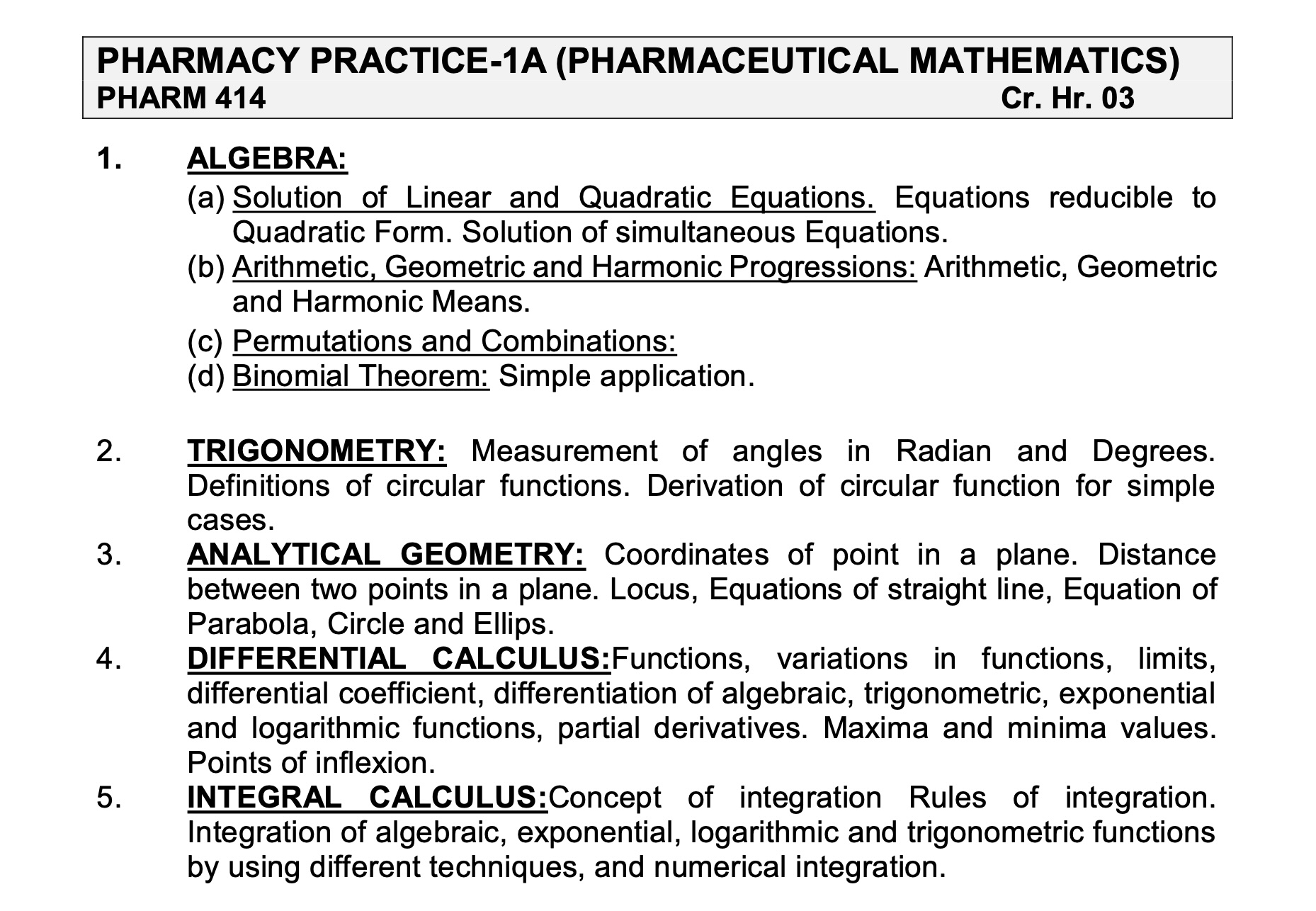
10-PHARMACY PRACTICE-1A (PHARMACEUTICAL MATHEMATICS)
1. ALGEBRA:
(a) Solution of Linear and Quadratic Equations. Equations reducible to
Quadratic Form. Solution of simultaneous Equations.
(b) Arithmetic, Geometric and Harmonic Progressions: Arithmetic, Geometric
and Harmonic Means.
(c) Permutations and Combinations:
(d) Binomial Theorem: Simple application.
2. TRIGONOMETRY: Measurement of angles in Radian and Degrees.
Definitions of circular functions. Derivation of circular function for simple
cases.
3. ANALYTICAL GEOMETRY: Coordinates of point in a plane. Distance
between two points in a plane. Locus, Equations of straight line, Equation of
Parabola, Circle and Ellips.
4. DIFFERENTIAL CALCULUS:Functions, variations in functions, limits,
differential coefficient, differentiation of algebraic, trigonometric, exponential
and logarithmic functions, partial derivatives. Maxima and minima values.
Points of inflexion.
5. INTEGRAL CALCULUS:Concept of integration Rules of integration.
Integration of algebraic, exponential, logarithmic and trigonometric functions
by using different techniques, and numerical integration.
and logarithmic functions, partial derivatives. Maxima and minima values.
Points of inflexion.